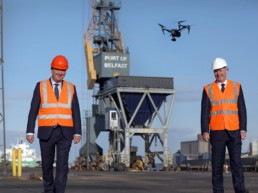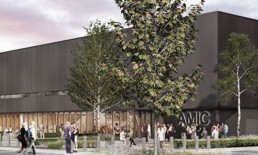
As part of the Belfast 5G Innovation Region programme, Queen’s University Belfast is harnessing 5G, Building Information Modelling (BIM), Digital Twin technology and robotics to support the design and construction of their £100 million, state-of-the-art Advanced Manufacturing Innovation Centre (AMIC).
The challenge
The construction of buildings and the management of building sites presents several challenges for the construction industry including safety issues, the management of people and equipment on site, and the resources and time required to carry out construction processes and site inspections.
The solution
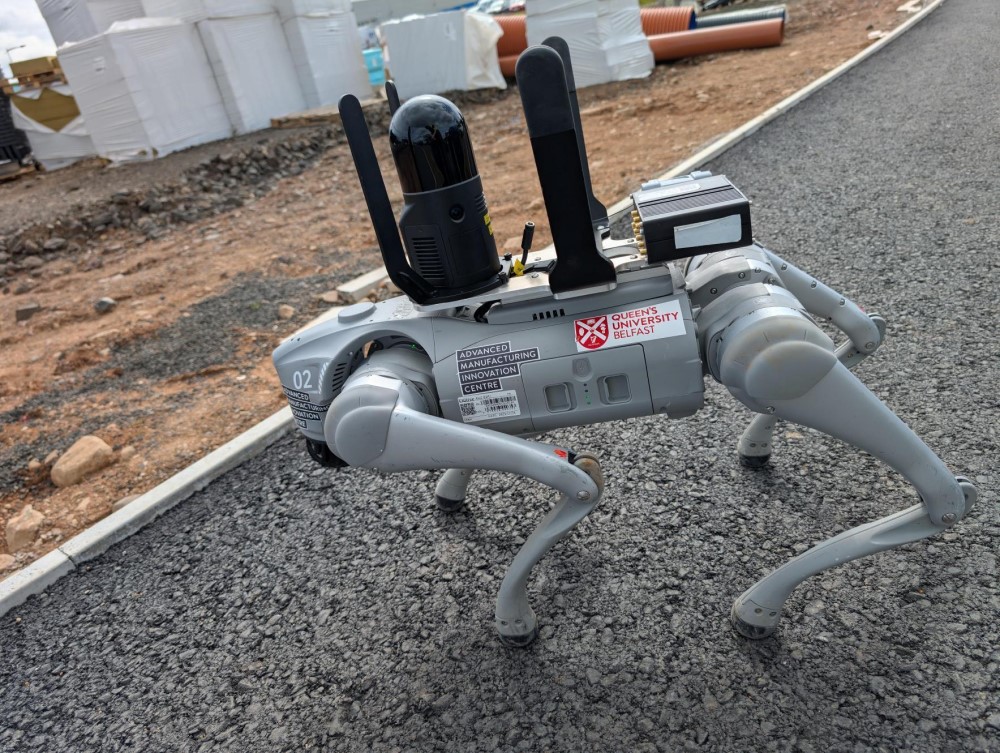
Queen’s University Belfast worked with BT to deploy a private 5G network at the AMIC construction site using a temporary mast on a trailer. AMIC is harnessing the 5G network to connect robotics systems, drones and IoT sensors to support the construction phase of the new centre. This includes lidar scanning to monitor the quality and progress of the build. 5G also enables the speedy optimisation, reconfiguration, and improved performance of robotics systems. IoT sensor monitoring of site assets increases efficiency of on-site reporting, collaboration and interaction between on-site and off-site stakeholders, and improved health and safety monitoring.
Benefits
- Accelerated building processes.
- Efficient monitoring of quality and progress of construction.
- Efficient use of resources.
- Improved building site management.
- Increased safety of site workers and visitors.